

Forget diggers, concrete mixers, and traditional formwork systems.
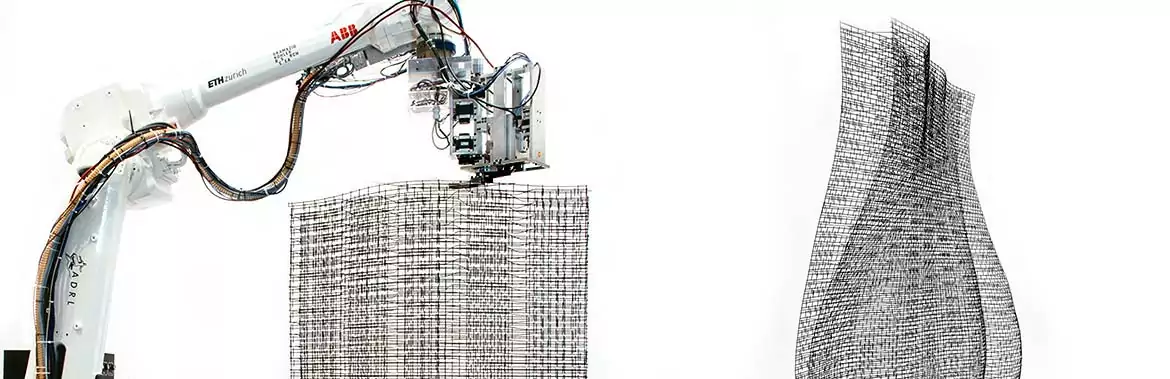
If researchers at ETH Zürich have their way, future construction sites may look radically different-featuring mobile robots 3D-printing intricate steel mesh structures directly on site.
This emerging technology, known as Mesh Mould, could redefine how buildings are designed, engineered, and constructed.
From Conventional Construction to Digital Fabrication
Today's reinforced concrete construction follows a familiar process:
1. Steel reinforcement bars are assembled
2. Concrete is poured into temporary wooden formwork
3. The formwork is removed after curing
While effective, this method has major limitations:
- Formwork is often custom-made and discarded after single use
- Complex shapes are expensive to produce
- Construction waste is significant
- Design flexibility is restricted
As a result, most buildings rely on standardized geometric forms.
Mesh Mould: A Structural Skeleton Without Formwork
Mesh Mould introduces a fundamentally different approach.
Instead of using traditional formwork, robots fabricate a fine steel mesh skeleton layer by layer.
This steel mesh acts as:
> both reinforcement and structural mold for concrete.
Once completed, concrete is poured into and around the mesh structure, forming a load-bearing element of almost any geometry.
The key breakthrough is simple:
> the structure itself replaces the need for temporary molds.
Why Steel Is Critical to the System
Mesh Mould depends heavily on the unique properties of steel:
- High tensile strength
- Structural flexibility
- Weldability and robotic shaping capability
These properties allow steel to be:
- precisely formed by robotic systems
- stable enough to hold concrete under pressure
- adaptable to complex architectural geometries
In advanced construction supply chains, high-performance steels-including reinforced structural grades and corrosion-resistant alloys-are essential for enabling such digitally fabricated systems.
Industrial material suppliers such as Jiangsu Cunrui Metal Products Co., Ltd. support modern engineering sectors by providing a range of steel and alloy materials used in construction, infrastructure, and structural fabrication environments where strength, formability, and reliability are critical.
Eliminating Formwork: A Major Shift in Construction Logic
In conventional reinforced concrete construction, formwork is one of the most resource-intensive elements.
It is:
- expensive to design for complex shapes
- labor-intensive to assemble
- typically discarded after use
Mesh Mould eliminates this step entirely.
Because the steel mesh is dense and precisely structured:
- concrete does not leak through
- no external mold is required
- structural shape is defined digitally, not manually
This fundamentally changes the economics of architectural design.
Sustainability Benefits of Mesh Mould Technology
One of the most significant advantages of this system is material efficiency.
By removing formwork and optimizing reinforcement placement, Mesh Mould can:
- reduce timber consumption
- minimize construction waste
- lower overall material usage
- improve design efficiency
In addition, digital fabrication allows engineers to place material only where it is structurally required, reducing unnecessary mass.
This makes the system particularly attractive for sustainable construction strategies.
Interdisciplinary Engineering Innovation
The development of Mesh Mould is not driven by a single discipline.
It combines expertise from:
- architecture
- robotics
- structural engineering
- materials science
Researchers at ETH Zürich, including teams led by Gramazio Kohler Research, have demonstrated that robotic fabrication can achieve structural precision that is difficult to replicate manually.
Recognition and Real-World Testing
The project has already received significant recognition, including the Swiss Technology Award in the "Inventors" category.
Beyond laboratory research, Mesh Mould is being tested in real-world conditions at the NEST experimental building in Switzerland.
NEST functions as a living research structure where new construction technologies are integrated into modular building sections.
Here, Mesh Mould is being applied in:
> load-bearing concrete wall systems.
While still experimental, this represents a critical step toward practical adoption.
Why This Matters for the Future of Architecture
Construction innovation often progresses in slow, incremental steps.
However, historically, breakthroughs such as:
- the Roman arch
- steel-frame skyscrapers
- elevator systems
have fundamentally reshaped urban development.
Mesh Mould belongs to this category of structural innovation.
If fully developed, it could enable:
- highly customized architectural forms
- reduced material waste
- automated construction workflows
- more sustainable urban infrastructure
In essence, it shifts construction from manual assembly to digitally guided structural manufacturing.
Final Thoughts
Mesh Mould represents more than a new construction technique-it represents a shift in how buildings are conceived.
Instead of forcing design into standardized molds, architects may soon design structures that are:
> fabricated directly into their final form using robotic steel mesh systems.
If successful, this technology could redefine the relationship between steel, concrete, and architecture itself-opening a new chapter in sustainable, digitally driven construction.
About Industrial Material Support
Advanced construction systems like Mesh Mould rely on high-performance steel materials with precise mechanical properties and structural reliability.
Companies such as Jiangsu Cunrui Metal Products Co., Ltd. contribute to the broader engineering ecosystem by supplying industrial-grade steel and alloy materials widely used in infrastructure, construction, and advanced fabrication applications where strength, durability, and adaptability are essential.


