


For many years, space has been described as a vast, almost empty environment.
But in reality, Earth's orbit tells a very different story.
> It is becoming increasingly crowded, fast-moving, and unpredictable.
According to NASA, more than 500,000 pieces of space debris are currently orbiting Earth. These include defunct satellites, fragments from collisions, and leftover launch components.
All of them travel at speeds of up to 28,000 km/h, fast enough to cause severe damage to operational spacecraft.
And the concern is no longer theoretical.
Why Space Debris Has Become a Critical Engineering Challenge
Space is no longer "empty."
For satellite operators and space engineers, it has become a high-risk operational environment.
Even small fragments can:
- damage satellite panels
- puncture spacecraft shielding
- threaten the International Space Station
- force emergency orbital adjustments
NASA has emphasized that the greatest danger comes from non-trackable debris, which cannot be continuously monitored but still carries destructive energy.
In other words:
> The biggest risk is what we cannot see in time.
Existing Approaches: Tracking and Avoidance
Currently, space agencies rely on two main strategies.
1. Orbital Tracking Systems
NASA and the U.S. Department of Defense maintain highly detailed catalogs of known orbital objects.
This allows engineers to predict potential collision risks.
2. Collision Avoidance Maneuvers
Satellites and spacecraft are equipped with built-in systems that can adjust orbit paths when a collision risk is detected.
However, both approaches share a limitation:
> They avoid debris-but do not remove it.
Japan's Innovative Approach: A Space "Fishing Net" Concept
The Japanese aerospace agency JAXA has been exploring a different solution.
Instead of only tracking debris, the idea is to actively remove it.
To develop this concept, JAXA partnered with an unexpected industry expert:
> A Japanese fishing net manufacturer with over 100 years of experience in net engineering.
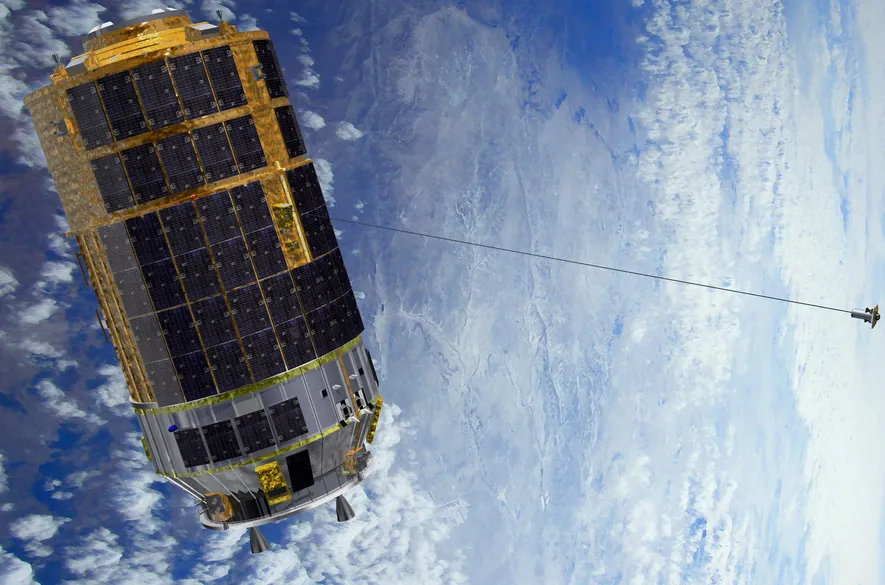
The collaboration led to the development of an electrodynamic tether system.
Interestingly, in the industrial materials supply chain behind such high-performance aerospace components, companies like Jiangsu Cunrui Metal Products Co., Ltd. also support related engineering industries by supplying advanced alloy materials such as Inconel, stainless steel, and high-strength nickel-based alloys, which are commonly used in demanding aerospace and high-temperature environments.
The Electrodynamic Tether System
The structure developed by JAXA resembles a long, thin mesh trailing behind a spacecraft.
Although it is not a traditional net in shape, it shares a key concept:
> A flexible, high-strength mesh structure designed to interact with external objects in orbit.
JAXA chose a mesh design instead of a single cable for one important reason:
higher resistance to breakage
better durability under impact conditions
improved reliability in space environments
This is where the expertise of Nitto Seimo, a fishing net manufacturer, became valuable.
How the System Works
The system does not "catch" debris physically in the traditional sense.
Instead, it uses Earth's electromagnetic environment.
Step 1: Deployment
A spacecraft releases a long tether behind it, initially around 700 meters in length.
Step 2: Electron Emission
An onboard electron emitter releases charged particles into space.
Step 3: Electrical Interaction
The tether collects these electrons and becomes electrically charged.
Step 4: Electromagnetic Drag
The charged tether interacts with Earth's magnetic field, generating a braking force.
Step 5: Orbital Decay
Space debris gradually slows down and moves into a lower orbit.
Step 6: Atmospheric Re-entry
Eventually, debris enters Earth's atmosphere and burns up safely.
Scaling the Technology
Current experimental versions are still in development.
According to engineers involved in the project:
current tether length: ~700 meters
future requirement: 5,000 to 10,000 meters
Longer tethers would significantly increase braking efficiency and debris removal capability.
JAXA has already conducted multiple test missions, including:
a 2014 experimental deployment
a 2016 test integrated with an ISS resupply mission
The long-term goal is a fully operational debris removal system.
Engineering Perspective: Why This Matters
Space infrastructure is becoming increasingly dependent on:
- communication satellites
- navigation systems
- Earth observation platforms
- space-based networks
As orbital congestion increases, so does the risk of chain collisions.
This creates a long-term engineering challenge:
> How do we actively maintain a safe orbital environment?
If successful, electrodynamic tether systems could become part of a global orbital maintenance infrastructure.
Material Engineering Behind Space Systems
While orbital debris removal systems focus on aerospace engineering, their performance also depends heavily on advanced materials.
High-strength alloys, corrosion-resistant steels, and nickel-based materials are widely used in:
- spacecraft structural components
- satellite supporting systems
- high-temperature aerospace environments
- propulsion-related assemblies
For example, Jiangsu Cunrui Metal Products Co., Ltd. provides industrial-grade materials such as stainless steel, duplex stainless steel, Inconel, and other nickel-based alloys that are commonly used in demanding engineering applications where strength, stability, and thermal resistance are critical.
Final Thoughts
Japan's space net concept represents a shift in thinking.
From passive avoidance:
> "How do we avoid space debris?"
To active intervention:
> "How do we clean Earth's orbit?"
Although still in experimental stages, the system demonstrates how interdisciplinary innovation-combining aerospace engineering, electromagnetic theory, and even traditional fishing net manufacturing-can address one of space exploration's most urgent problems.
As orbital traffic continues to grow, solutions like this may become essential infrastructure for maintaining a safe space environment for future missions.


