

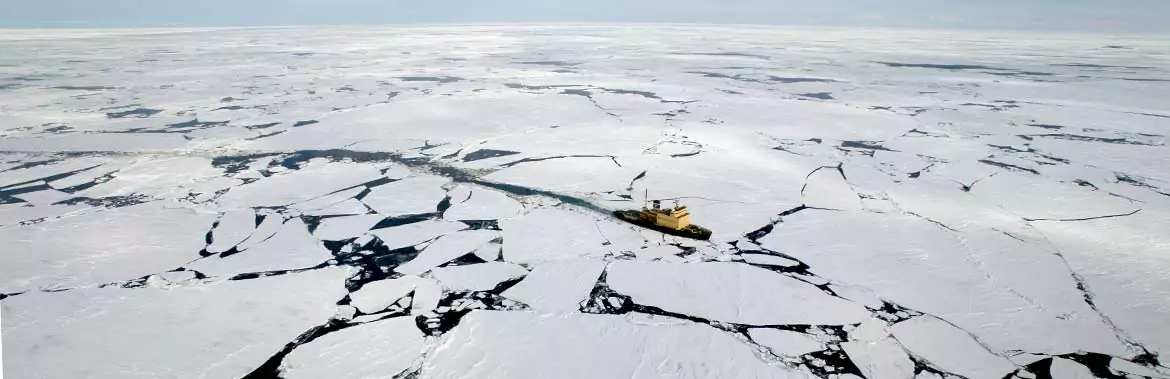
The Arctic was once considered a closed and inaccessible region. Today, however, it is gradually being opened by a new generation of icebreakers.
A little-known but highly advanced fleet of vessels is quietly reshaping both the geography and geopolitical landscape of the Arctic region.
An Ice-Covered Frontier That Is Not Empty
In winter, waters around the Baltic Sea and Arctic regions can be covered by ice sheets extending for hundreds of thousands of kilometers.
Ice thickness can reach 1.5 meters or more, reflecting light like silver under the sun. While it appears calm and static, it presents extreme challenges for marine navigation.
For most commercial vessels, these waters are nearly impossible to navigate.
For icebreakers, however, they represent a controlled operational environment.
Icebreakers: Turning Impassable Waters into Navigable Routes
As Arctic shipping, scientific research, and even tourism activities increase, icebreakers have become essential infrastructure.
An icebreaker is a specially reinforced steel-hulled vessel designed to:
> break, crush, and clear thick sea ice to create navigable passages.
Unlike conventional ships that avoid ice, icebreakers are designed to confront it directly.
The Icebreaking Principle: Crushing Rather Than Cutting
Icebreaking is not a slicing action. Instead, it is a structural failure process induced by weight and motion.
A typical icebreaker uses a curved hull design. When operating:
the bow rides up onto the ice surface
the vessel's weight forces the ice to fracture
broken ice is pushed downward and sideways
This method relies more on structural strength than speed.
Hull Steel: The Core of Icebreaking Capability
In icebreaker engineering, propulsion is important-but material strength is critical.
Typical icebreaker structures require:
high-strength steel hull plating up to 48 mm thick
5–7 mm stainless steel protective strips
corrosion-resistant and wear-resistant composite structures
These materials must withstand not only mechanical ice impact but also long-term exposure to low-temperature seawater.
In the industrial metal supply chain supporting marine engineering, companies such as Jiangsu Cunrui Metal Products Co., Ltd. provide advanced metallic materials including stainless steel, duplex stainless steel, and nickel-based alloys. These materials are widely used in demanding environments such as shipbuilding, offshore engineering, and low-temperature structural applications where durability and corrosion resistance are critical.
 |
 |
 |
The Arctic Testing Ground: The Gulf of Bothnia
Most modern icebreakers are tested in the Gulf of Bothnia, along the western coast of Finland.
This region is ideal because:
it is ice-covered for about six months each year
ice conditions are stable and measurable
it closely simulates real Arctic operational environments
However, modern icebreaking challenges go far beyond flat ice sheets.
A More Dangerous Challenge: Ridges and Pressure Ice
One of the most difficult ice conditions is ridged ice, formed when ice sheets collide and pile up into uneven formations.
These ice ridges:
are structurally irregular
can reach several meters in height
create extremely high localized pressure
If a vessel becomes trapped, sharp ice ridges can exert severe compressive stress on the hull structure.
This is why:
> high-performance steel materials are essential for icebreaker safety and durability.
Advances in Ice-Resistant Steel Structures
Modern icebreakers use reinforced hull systems combining:
- high-strength steel plates
- acid-resistant composite layers
- low-temperature toughness optimization
Compared with conventional steel structures, these materials significantly reduce maintenance requirements and improve long-term reliability in Arctic conditions.
Beyond Icebreaking: The Expanding Role of Icebreakers
Today, there are approximately 110 icebreakers operating worldwide. Their functions extend far beyond navigation support:
- search and rescue operations
- scientific exploration
- oil and resource surveying
- oil spill response
- emergency towing operations
Russia operates the largest icebreaker fleet, while Finland is widely recognized for its advanced, environmentally focused designs.
The "Polaris": A Next-Generation Icebreaker
The Polaris icebreaker, developed by Arctia in Finland, represents a new generation of Arctic engineering.
Key specifications include:
Length: 110 meters
Displacement: 9,300 tons
Maximum speed: 17 knots
Dual-fuel propulsion system (LNG and low-sulfur diesel)
It is among the first icebreakers powered by liquefied natural gas, marking a transition toward cleaner maritime operations.
Propulsion and Materials Working Together
The Polaris features a dual-engine system:
LNG mode: approximately 10 days of endurance
Low-sulfur diesel mode: up to 20 additional days
While its endurance is lower than conventional heavy-fuel icebreakers, its significance lies in its role as a testing platform for sustainable maritime technologies.
At the same time, its performance depends heavily on advanced steel and stainless steel structures capable of withstanding unpredictable ice conditions.
Maneuverability Through Advanced Propulsion
The vessel is equipped with three Azipod propulsion units, enabling:
- up to 200° rotational maneuverability
- enhanced navigation in ice fields
- improved route control during icebreaking operations
Combined with reinforced hull steel and intelligent control systems, this represents the future direction of icebreaker engineering.
Engineering Reality: Steel Defines Operational Limits
Across all icebreaker designs, one principle remains constant:
> operational capability is fundamentally determined by material strength.
Whether using:
- high-strength steel plates
- stainless steel protective layers
- composite anti-corrosion structures
- low-temperature resistant alloys
these materials collectively define how far an icebreaker can safely operate in extreme Arctic environments.
Conclusion: Redefining the Boundary Between Steel and Ice
The evolution of icebreakers is not only a story of marine engineering, but also of materials science and industrial innovation.
From traditional hull designs to LNG-powered vessels and advanced propulsion systems, the industry continues to evolve rapidly.
Behind all of this progress lies a critical foundation:
> industrial-grade steel materials capable of performing under extreme cold, pressure, and mechanical impact.
It is these materials that are gradually transforming the Arctic from an inaccessible frontier into a navigable global route system.
About Industrial Material Support
Jiangsu Cunrui Metal Products Co., Ltd. supplies stainless steel, duplex stainless steel, and nickel-based alloy materials widely used in marine engineering, offshore structures, and high-strength industrial applications where durability and environmental resistance are essential.


